What Is a Showing Agent in Real Estate?
The short answer
A showing agent is a licensed real estate professional who conducts a property tour on behalf of another agent, team, or brokerage. The showing agent handles access, the tour itself, security, observations, and feedback. The primary buyer's agent keeps the client relationship, the advice, the negotiation, and the offer. Exact duties depend on state law, brokerage policy, and the terms of the assignment.
The role exists because real estate calendars collide. A buyer wants to see a house tonight; their agent is at a listing appointment across town. An inspector needs access at 9 AM; the agent has a closing at 9:30. Either the client waits — and in a fast market waiting loses houses — or another licensed professional covers the door.
You will also hear "showing assistant", "showing partner", and "coverage agent" used for overlapping arrangements. They are not perfectly interchangeable, and the differences matter for pay and for who is responsible for what. Both are covered below.
What does a showing agent do?
The job is narrower than a full buyer's-agent engagement and more demanding than simply unlocking a door. A typical assignment runs like this:
- Accept the assignment and confirm the property, time window, and fee.
- Read the access instructions — lockbox, alarm code, gate, listing-agent contact, parking.
- Confirm timing with the requesting agent and with the buyer or visitor.
- Arrive early enough to verify access actually works before the buyer is standing outside.
- Meet the buyer or authorized visitor and confirm who they are.
- Conduct the tour professionally, following the requesting agent's instructions.
- Follow property-security procedures — lights, doors, valuables, pets, seller belongings.
- Stay inside the assigned role and avoid advice the requesting agent has not authorized.
- Record factual observations and the buyer's reactions.
- Secure the property on the way out and confirm the lockbox is closed.
- Check out and send feedback promptly, while the detail is still fresh.
The feedback step is the one that separates a covering agent people re-book from one they do not. "They liked it" is not feedback. "They loved the kitchen, flinched at the road noise on the west side, and asked twice whether the roof had been replaced" is a report the requesting agent can act on with their client.
What a showing agent usually does not do
Unless separately authorized and permitted where they practice, a coverage showing agent generally does not:
- Replace the buyer's primary agent or create a new agency relationship.
- Solicit the buyer during or after the showing.
- Advise on offer price or negotiating strategy.
- Draft, present, or submit an offer.
- Negotiate terms with the listing side.
- Make legal, inspection, lending, or tax representations.
- Disclose confidential information about either party.
These are conventions of the coverage arrangement rather than universal legal rules, and the boundaries shift with state regulation and brokerage policy. Confirm the specifics with your broker before you accept paid showing work — this article is general information, not legal advice.
Showing agent vs. buyer's agent
The distinction people are usually reaching for is about representation, not about who physically opens the door.
| Responsibility | Coverage showing agent | Buyer's agent |
|---|---|---|
| Opens and secures the property | Yes | Yes |
| Conducts the property tour | Yes | Yes |
| Holds the primary client relationship | Usually no | Yes |
| Advises on offer strategy | Usually no | Yes |
| Drafts and submits offers | Usually no | Yes |
| Negotiates terms | Usually no | Yes |
| Manages the transaction to closing | No | Yes |
| Provides post-showing feedback | Yes | Sometimes |

A showing specialist embedded in a real estate team may carry broader responsibilities than a one-off coverage agent — some team showing partners do write offers under their team lead's supervision. The table above describes the common marketplace-style coverage arrangement, which is deliberately narrow.
Showing agent vs. showing assistant
The terms overlap in conversation but usually point at different employment shapes. "Showing assistant" most often means a licensed person attached to one team — salaried, hourly, or on a split — who shows that team's buyers repeatedly and learns their preferences.
"Showing agent" in the coverage sense usually means an independent licensee taking discrete paid assignments from agents they may never meet. The work is per-job rather than ongoing, the pay is per showing rather than per pay period, and the relationship ends when the feedback is filed.
Neither is inherently better. The assistant role trades flexibility for consistency; the coverage role trades consistency for control over your own calendar.
Does a showing agent need a real estate license?
Compensation for activities that require a real estate license is regulated at the state level, and the rules are not uniform. In most common coverage situations the person conducting the tour is an active licensee working under a brokerage, because showing property to a prospective buyer for compensation is generally licensed activity.
What varies is the detail: whether an unlicensed assistant may open a door without conducting the tour, how compensation must flow through the brokerage, what disclosures are required when someone other than the buyer's agent appears, and what the local MLS and lockbox rules permit.
Confirm the rules with your designated broker and your state regulator before accepting paid showing work. Treat any blanket claim that showing coverage is "always fine" or "always prohibited" with suspicion — including this one.
Who hires a showing agent, and when
The demand is less about laziness and more about physics — one agent cannot be in two places at once. Coverage is typically requested by individual buyer's agents, real estate teams, brokerages managing capacity, listing agents needing property access, and property managers running rental tours.
The recurring situations:
- Two buyers want to tour at the same hour.
- A same-day request lands while you are already committed.
- Travel, illness, or a family obligation takes you out of the market.
- An inspector, appraiser, photographer, or contractor needs to be let in.
- An open house needs a host while you are elsewhere.
- A rental tour is worth covering but not worth a round trip.
- A lockbox or access run has to happen inside a narrow window.
How do showing agents get paid?
There are several models in the market, and the differences are significant for anyone deciding whether the work is worth it:
- Salary — a team employs a showing assistant and pays regardless of volume.
- Hourly — common for open-house hosting and floor coverage.
- Per showing — a flat fee per assignment, the dominant model for independent coverage.
- Team split or bonus — a share of the commission when a showing leads to a closing.
- Marketplace fee — a platform fee set by the requesting agent, paid on completion.
- Favor economy — no money changes hands, which works until it does not.
On ShowingMarket the requesting agent sets a fee when posting — currently between $45 and $400 depending on distance, timing, and scope — and the covering agent keeps 90% of it. The fee and the payout are visible before anyone commits. Payment is card-authorized when the request is posted and captured only after the requesting agent approves the completed showing. Product terms can change, so treat the pricing page as the current source rather than this paragraph.
How much can a showing agent make?
There is no credible national average, and anyone quoting one precisely is guessing. What actually determines the number:
- Local market pricing and how much coverage demand exists.
- Drive time — a 40-minute each-way showing at the same fee is a different job.
- Appointment length and how many homes are on the tour.
- Urgency: same-day and evening requests price higher.
- Property type and complexity, including gated or tenant-occupied access.
- Open-house hosting is usually priced by the block, not the door.
- Your brokerage split, if your broker takes one on coverage income.
- Platform fees, taxes, mileage, and vehicle costs.
The honest way to evaluate it is per hour including drive time, not per showing. A $120 fee is excellent for a 25-minute condo tour ten minutes away and mediocre for three houses across a metro. We work through the arithmetic in how much showing agents make.
How to become a showing agent
- Hold an active real estate license in the state where you will show.
- Affiliate with a brokerage, and confirm your broker permits coverage work and how compensation must flow.
- Check your errors-and-omissions coverage applies to showings for other agents.
- Learn the local MLS, lockbox, and access rules — including which lockbox system dominates your market.
- Build a profile that a stranger can trust: photo, brokerage, areas, and what you are good at.
- Set realistic coverage areas. Claiming a 60-mile radius you will not actually drive is how you earn your first bad rating.
- Decide your availability and hold to it — evenings and weekends are when the demand is.
- Use a repeatable checklist so every showing produces the same quality of feedback.
- Keep records for income, mileage, and taxes from the first job, not the twentieth.
Newly licensed agents can start here sooner than most other paid work, because the assignment is bounded and the requesting agent supplies the instructions. What you can do with a real estate license covers the wider set of options.
Is showing work worth it for new agents?
It is genuinely useful, and it is not a business on its own. The case for it:
- Real reps with real buyers in real houses, which no course provides.
- Property and neighborhood knowledge accumulated in the only way it sticks.
- Relationships with established agents who are, by definition, busy enough to need help.
- Income that does not require a pipeline you do not have yet.
- A defensible answer to "how many homes have you shown?"
The limits are equally real: volume is inconsistent, driving costs are yours, the client is not and does not become yours, and the demand clusters into evenings and weekends. Treat it as paid apprenticeship and supplemental income rather than a replacement for building your own book. How new agents make money in year one puts it alongside the alternatives.
Showing safety, briefly
You are meeting strangers alone in empty houses, often after dark. The basics are not optional:
- Confirm the visitor's name and details before you arrive.
- Tell someone where you are and when you expect to be done.
- Arrive with a charged phone and keep it on you, not in your bag.
- Let the visitor move ahead of you through the house; keep exits behind you.
- Do not enter a situation that feels wrong. No showing is worth it.
- Document anything that goes wrong while you still remember it.
- Follow your brokerage's emergency procedure — and know it before you need it.
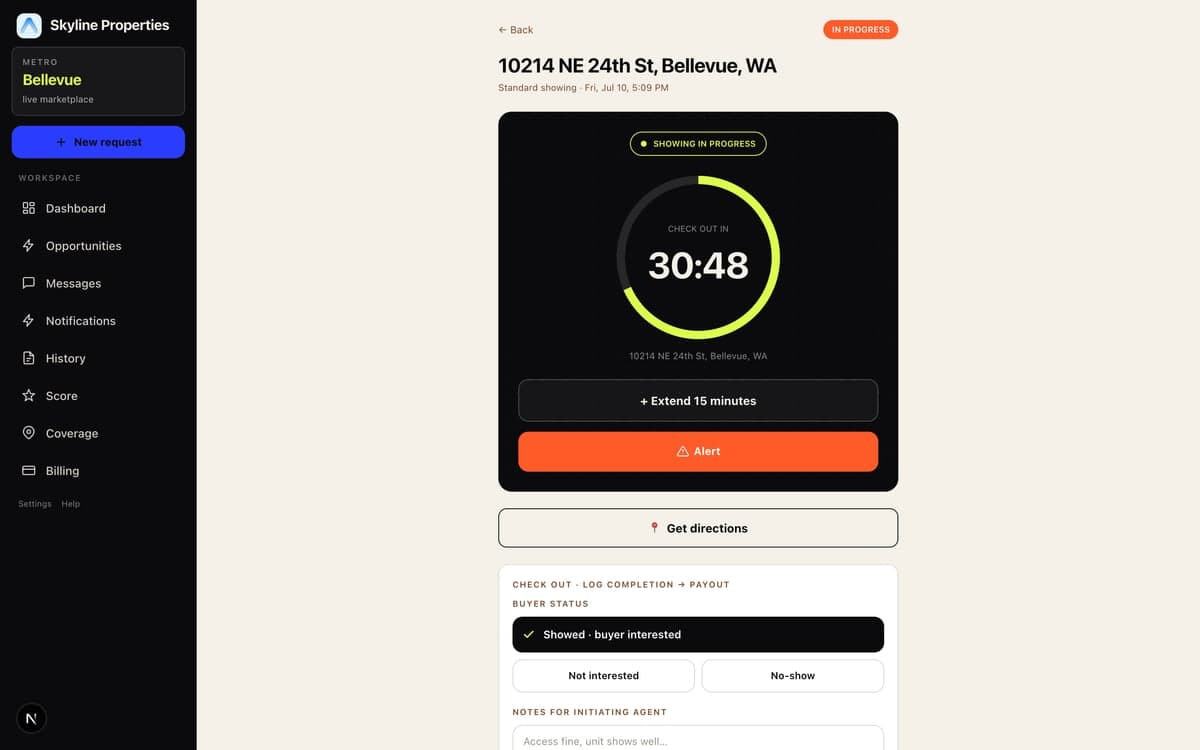
Platforms can help but do not replace judgment. On ShowingMarket a safety timer runs from check-in, and if you do not check out or extend it, the requesting agent and your emergency contact are alerted. Check-in and check-out each capture a GPS fix and timestamp on the showing record. That is a backstop, not a substitute for telling a real person where you are.
Where to find showing work
Coverage work comes from three places: the agents you already know, your brokerage's internal network, and marketplaces that match requests to licensed agents nearby. The first two are higher trust and lower volume; the third is the reverse.
ShowingMarket is available to licensed agents nationwide, and deepest in the Seattle metro — Bellevue, Kirkland, Redmond, Sammamish, Issaquah, Bothell, Woodinville, and Mercer Island. If you are licensed in Washington and work those cities, you can join free, set your coverage areas, and see paid requests near you. The full flow from posting to payout is in how it works.
Comparing options first is reasonable, and we would rather you did: the best showing agent services covers the alternatives including where they beat us.
Common questions
Is a showing agent the same as a buyer's agent? No. A showing agent conducts the tour; the buyer's agent represents the buyer and keeps the relationship, the advice, and the offer.
Can a showing agent write an offer? Not in a standard coverage arrangement. A team-based showing partner sometimes does, under their team lead's supervision and where permitted.
Who pays the showing agent? The requesting agent or their team, not the buyer. On a marketplace, the requesting agent sets and pays the fee.
Can a showing agent contact the buyer afterward? They should not, and on ShowingMarket every claim carries a non-solicitation agreement accepted at the moment the job is taken.
Is a showing agent an employee or a contractor? Both exist. Team showing assistants are often employees; independent coverage agents are typically contractors. Classification is a legal question for your broker and accountant.
Can showing agents host open houses? Yes, and hosting is often better paid per hour than a single tour because it is booked as a block. See get paid hosting open houses.
Can a listing agent use a showing agent? Yes — for access, inspections, appraisals, and vendor visits. When a listing agent can't show the property covers that case.
Join free, add your license details, and see paid requests in your coverage area.
Sign up for free today