Compliance software for the part of the job that happens at the property.
Every other tool in this category governs the transaction — the documents attached to a deal after it is agreed. This governs the visit that comes weeks earlier: who opened the door, under what instruction, and whether your brokerage's rules were actually met before anyone was paid. Your rules, enforced by the database rather than by the app asking nicely.
Transaction compliance is a solved problem. Showing compliance is not.
A brokerage already has somewhere to keep the deal file. What it usually has no system for is the licensed act that happens long before a file exists — an agent letting someone into a home they do not own, on the firm's behalf. That is where the agency-relationship question gets asked, and it is asked at the door, not at closing.
Listing agreements, disclosures, addenda, signatures, broker review of a completed file. Governed after there is a deal to govern. ShowingMarket does not do this and does not replace the platform you use for it.
Buyer showings, open houses and property access performed by one of your agents — what had to be acknowledged before they went, what was said at the door, where they physically were, and what evidence closed it out.
You choose the moment each rule bites
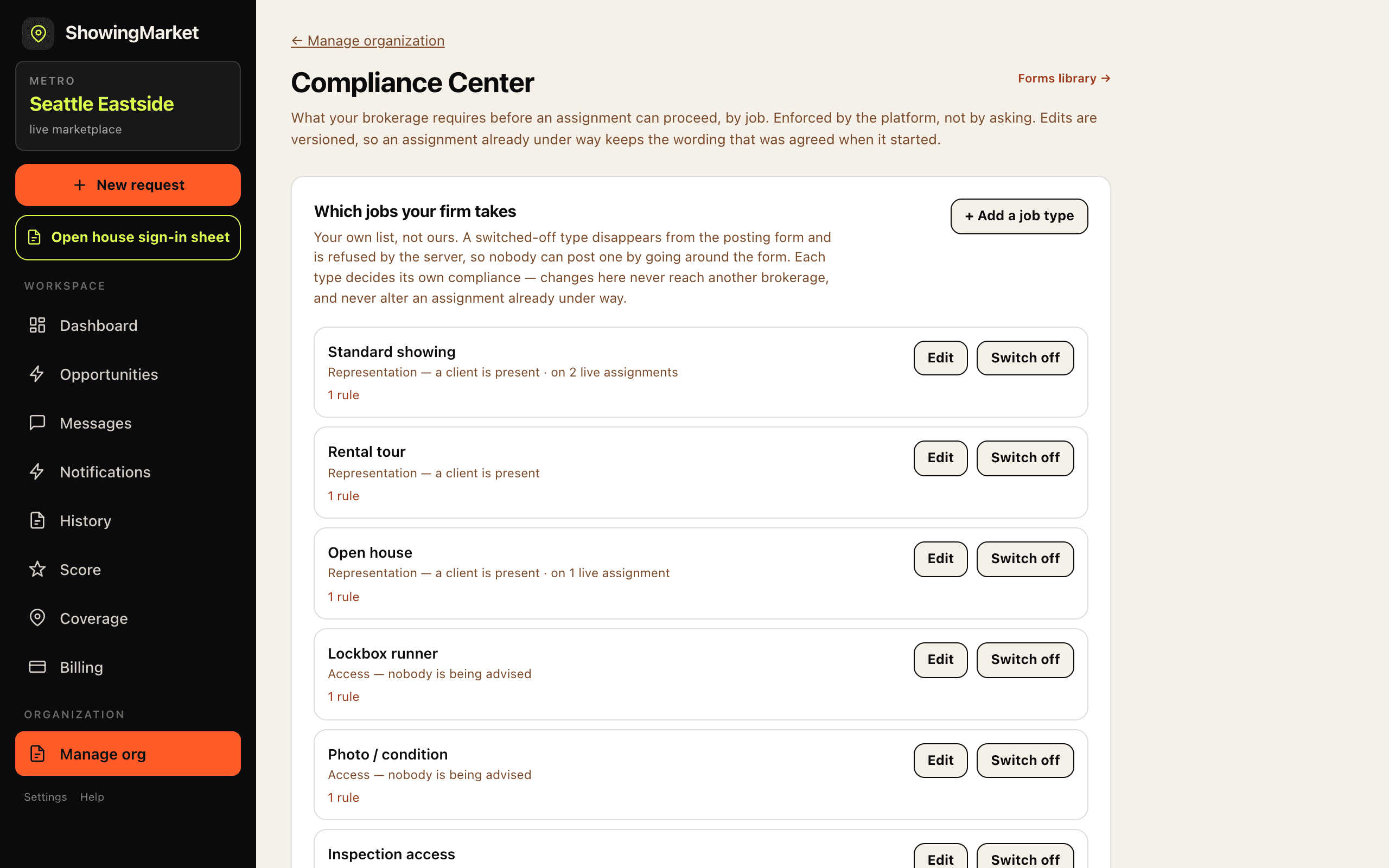
A requirement is not just a document — it is a document plus a deadline. You keep your own list of the jobs your agents take, in your own words, and for each one you decide what has to be signed and when. The platform refuses at that moment.
- 1Before it is postedA request cannot leave your brokerage until what you require at posting is on file. Nothing broadcasts half-formed.
- 2Before an agent takes itThe claim is refused until the covering agent has met what you ask of whoever accepts the work.
- 3Before check-inThe agent cannot start the visit at the property until the requirement due at arrival is satisfied.
- 4Before check-outThe visit cannot be closed out until what you require at the end has been completed.
- 5Before payment is releasedApproval and payout are held until the last requirement clears. The money is the final gate, not an afterthought.
The Compliance Center
Your job types down one side, what each requires down the other. This is the running product, not a rendering.
What holds up afterwards
Compliance software is judged the day someone asks you to prove something, not the day you configure it.
Publish a change and live work picks it up immediately — but an assignment already under way keeps the wording agreed at the start. A policy edit never rewrites what someone already accepted.
Not a report you have to remember to run. Assignments that cannot proceed, escalations first, aged from the moment they became a problem. Resolved items leave it, and every row links back to its audit trail.
Who was offered it, who took it, what was said, where they physically were at check-in and check-out, what evidence closed it, and what was paid. Entries appear only where a real timestamp exists — nothing is inferred.
An open-house attendee asks the host to represent them. The host raises it in one tap, the assignment stops, and they are shown your firm's own instruction — your words, not ours. Only a designated broker can resolve it, and only with a reason.
A block that clears names how it cleared. A completion and a broker override are recorded as different things, so the exceptions you waived are still findable a year later.
Counts at a glance, a CSV summary, or one assignment's full evidence package. The complete firm record exports as a single file — no ticket, no waiting period.
Questions brokerages ask
What is real estate compliance software?
Software that holds a brokerage's own rules — what has to be disclosed, signed, or acknowledged — and makes sure the work does not proceed until those rules are met. Most tools in this category cover the transaction: the documents attached to a deal after it is agreed. ShowingMarket covers the fieldwork before that: showings, open houses and property access performed by an agent on the firm's behalf.
How is this different from transaction management software like dotloop or Glide?
They govern the deal file. ShowingMarket governs the visit. If a licensed agent opens a door on your brokerage's behalf, that is a supervised act with its own disclosure and agency-relationship exposure, and it usually happens weeks before a transaction file exists. The two are complementary — this does not replace a transaction platform and does not try to.
Can requirements differ by job type?
Yes, and that is the point. You keep your own list of the jobs your agents take, in your own words, and set what each one requires. A buyer showing and a contractor let-in are not the same act and can carry entirely different requirements.
When exactly is a rule enforced?
You choose the moment for each requirement: before the job can be posted, before an agent can take it, before check-in, before check-out, or before payment is released. The platform refuses at that moment. It does not grey out a button and hope.
What happens if we change a rule while work is already under way?
Edits are versioned. An assignment already in progress keeps the wording that was agreed when it started, so a mid-flight policy change never rewrites what someone already accepted. New work picks up the new version immediately.
Who can override a requirement?
Only a designated broker, and only with a reason that is recorded. A resolved block names how it resolved — completed or overridden — so an override is visible as an override rather than blending into ordinary completions.
Can we get the record out?
Yes. A compliance report gives counts at a glance, a CSV summary, or one assignment's full evidence package. There is also a complete firm export — members, coverage, assignments, the full compliance trail and every document reference — as one file, with no ticket and no waiting period.
How much does the compliance software cost?
Nothing. Setting up an organization is free — no setup fee, no subscription, no seat licenses. Agents pay a per-showing fee only on completed paid work, and internal coverage can be set to no fee at all.
Your rules, refused at the door instead of noticed at the audit.
We set up your organization — job types, requirements, and the moment each one is due — free. See the whole supervision surface on the brokerage page, or tell us who you are and we'll take it from there.